
Tailoring Your Way of Working (WoW): Factors to Consider
My experience, after close to four decades in the professional world, is that you want to tailor your way of working (WoW) for the situation that you face. What factors should you consider when doing so, or more importantly, what factors motivate you to tailor your WoW to vary from the advice prescribed by methods and frameworks such as Scrum and SAFe? That is the focus of this article.
I’ve been thinking about this issue and applying those ideas in practice since the mid-00s. At IBM, I developed something called the Agile Scaling Model (ASM), which was similar at the time to Philipe Kruchten’s octopus model, which was developed in parallel to my work. Later, at Disciplined Agile Consortium (DAC), I evolved ASM into the Software Development Context Framework (SDCF). I evolved it once again at PMI into the Situation Context Framework (SCF) to remove the software bias from it. This article reflects my current thinking on this subject.
Tailoring Factors That Impact Your Way of Working
A tailoring factor is an issue or consideration that can influence how you or a team work. For example, the difficulty of the task or goal that you face will likely drive how sophisticated your approach will be. Your skill, either yours or your team’s, will also impact your way of working. And there are other tailoring factors, described below. Tailoring factors are also called complexity factors or even scaling factors, and I have used both terms in the past. I’ve come to recognize “tailoring factor” as the most accurate term for the concept.
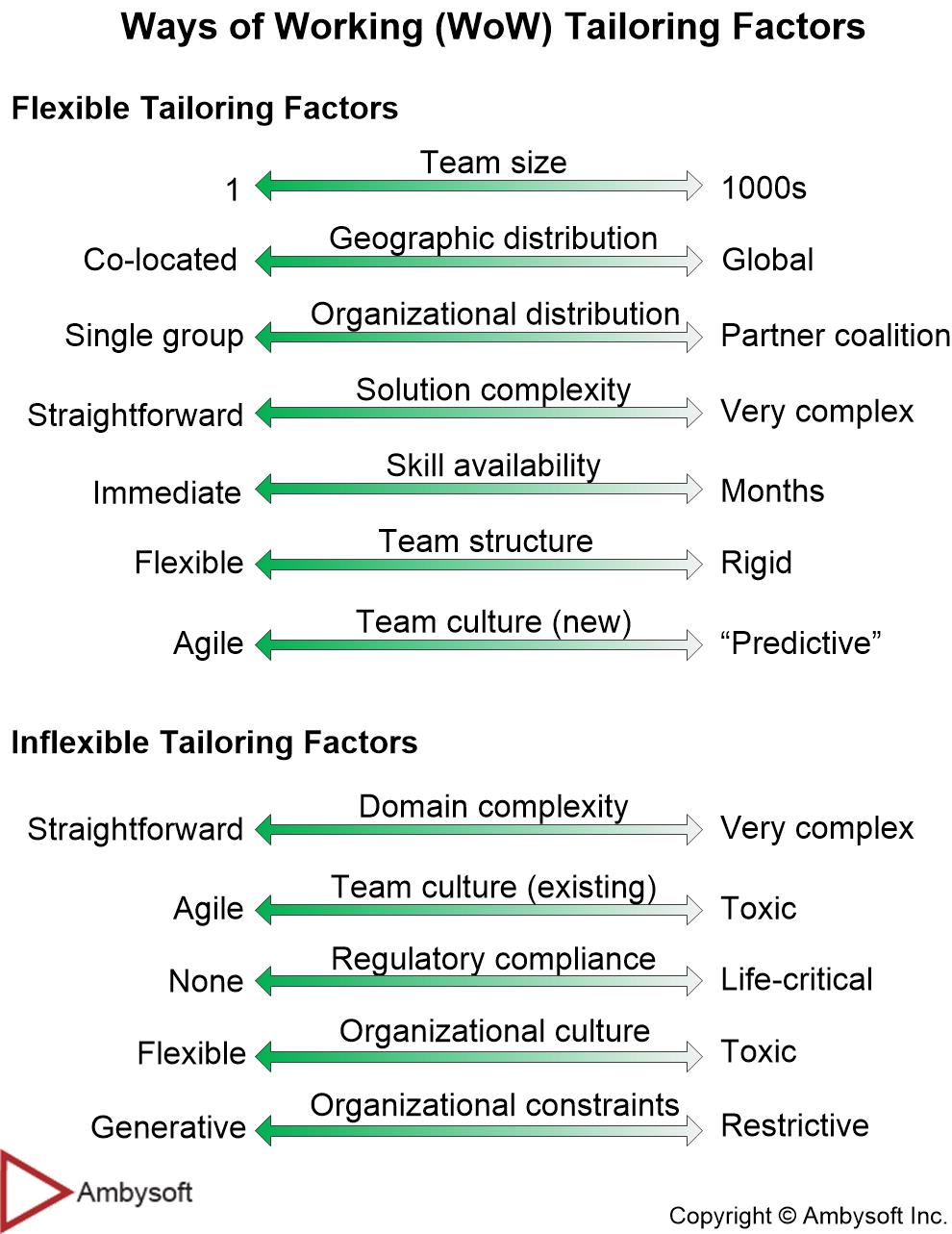
As you see in Figure 1, I have organized the tailoring factors into two categories: flexible factors that you should be able to influence and inflexible factors that you will have little influence over in the short term. In the past, I organized the tailoring factors into two categories: selection factors that influence your overall choice in approach and scaling factors which influence your overall choice of practices/strategies. While this categorization made a lot of sense, I suspect a better approach is to organize the factors into these two categories, as they are more applicable to tailoring.
Figure 1. The WoW tailoring factors (click to enlarge).
Flexible WoW Tailoring Factors You Likely Control
The following tailoring factors are typically under your control, or at least can be influenced by you:
- Team size. Teams can range in size from two people to thousands (organized into a team of teams). The larger the team, generally the greater the risk of failure due to greater coordination complexity.
- Geographic distribution. Team members may work side by side or may be on different sides of the planet. Geographic distribution becomes harder as the number of time zones between people increases – being longitudinally separated is tougher than being latitudinally separated.
- Organization distribution. When team members may work for the same organization, or perhaps line-of-business (LoB) within an organization, it is generally easier to collaborate than when multiple organizations are involved.
- Solution complexity. The greater the complexity of your solution architecture, the greater the chance that something will go wrong with it.
- Skill availability. The harder it is to find people with the required skills to do the job, the greater the risk of failure by the team.
- Team structure. Flexible team structures enable you to adapt to changes in your environment better than rigid structures do.
- Team culture (new). Interestingly, although I usually avoid the term predictive due to its deceptiveness (I’m being polite, it’s borderline unethical), it does in fact make sense in a small number of contexts to build a team culture that leans towards the traditional/predictive end of the spectrum.
Inflexible WoW Tailoring Factors That Aren’t Easily Influenced
The following tailoring factors are typically NOT under your control, and are often difficult to influence:
- Domain complexity. The higher the complexity/difficulty of the problem you’re taking on, the greater the chance that you’ll fail to address it.
- Team culture (existing). The greater the mismatch between your team culture and your chosen way of working, the greater your risk. For example, a problem where a predictive WoW makes sense should be taken on by a team with a predictive culture. Similarly, an agile WoW should be adopted by a team with an agile culture. Team culture can evolve, often requiring many months of coaching and organizational support.
- Regulatory compliance. A team addressing a problem requiring regulatory compliance must adopt a WoW that is compliant. Regulatory compliance required more sophisticated WoW than non-compliance. Life-critical compliance similarly requires more sophisticated WoW than financial regulatory compliance.
- Organizational culture. You inject risk when there is a mismatch between your organizational culture and your team culture; Your team is working and thinking in one manner but the teams it needs to collaborate with, or the people who are governing it, are working and thinking in another. Organizational culture can evolve, but it is difficult and either requires years to accomplish or a “near-death experience”.
- Organizational constraints. Organizational constraints include limited funding, personnel, time, and training/education support.
Acknowledgements
I’d like to thank Michel Thiry for his input regarding the labels on the factors, in particular “Predictive” for the less desirable (right side) option on Team culture (new). Although I would have preferred consistency with Team culture (existing) and Organization culture, both of which have “Toxic” for the less desirable option, the unfortunate fact is that your existing team or organizational culture may in fact be toxic, whereas it may make sense in some contexts to build a new, “predictive” culture in your team (and in your organization for that matter).